
- August 31, 2026
- Posted by: New SEO
- Category: Optometry Practice Management

In eye care, it is easy to focus only on clinical work like prescriptions, lenses, and patient outcomes. But every practice is also a business that depends on smooth operations. Many owners feel stuck working harder each year while profits stay flat and staff stress increases.
The difference between a practice that feels chaotic and one that runs efficiently comes down to systems.
At OptiRova, years of experience show that the most successful practices are not always the biggest or most well-known. They are the ones with clear, repeatable systems in place. When your processes are organized, you spend less time fixing problems and more time growing your practice.

Why Strong Systems Are Critical for Modern Optometry Practices?
The traditional model of running a practice relied heavily on the owner doctor making every decision. Without the doctor present, operations slowed. Today, that approach often leads to burnout and limits growth.
Strong systems are essential because they allow your practice to run smoothly, even without constant oversight. They create consistency, improve efficiency, and make scaling easier.
- Managed Care Pressure: With reimbursements becoming tighter, every step in your workflow needs to be efficient. Systems help ensure each patient visit remains profitable without sacrificing care quality.
- Staff Turnover: When processes are clearly documented, training new team members becomes faster and more effective. Instead of relying on verbal instructions, your team can follow proven steps.
- Practice Valuation: A well systemized practice is more attractive to buyers. Investors and buyers place a higher value on businesses that operate independently of a single individual.
- Patient Expectations: With growing technologies, patients expect convenience. From online booking to automated updates, systems help deliver a smooth and modern experience that builds trust and loyalty.
The 7 Essential Systems Every Optometry Practice Should Have
To move from daily chaos to consistent profitability, your practice needs structured systems that run in the background and support your team.
1. The Automated Patient Recall and Communication System
Keeping existing patients engaged is far more cost-effective than constantly trying to attract new ones. If your team is still making manual reminder calls, it is likely costing both time and revenue.
A digital system connects with your EHR and automatically sends reminders through text or even postcards at key intervals such as 12, 13, and 24 months.
It keeps your schedule full by reducing missed appointments and filling gaps without adding extra workload for your staff.
Practices that switch from manual to automated recall systems often see a 15 to 25 percent increase in kept appointments.
2. The Warm Hand Off and Optical Capture System
The moment a patient moves from the exam room to the optical area is one of the most important steps in the entire visit. It is also where many practices lose potential revenue.
Instead of ending the exam and sending the patient on their own, the doctor personally introduces them to the optician. A simple, clear recommendation is shared, such as the type of lenses or features needed based on the patient’s lifestyle.
This process transfers trust from the doctor to the optician. The patient feels guided rather than sold to, which increases confidence and improves the chances of completing the purchase in-house.
3. Comprehensive Billing and Revenue Cycle Management (RCM)
Many optometry practices lose a surprising amount of revenue due to small inefficiencies. Missed claims, coding errors, and unpaid copays can quietly reduce profits by 5 to 10 percent.
A strong system ensures insurance is verified at least 48 hours before the appointment. Copays are collected at check-in, and all claims are reviewed, corrected if needed, and submitted daily.
Accurate and timely claims processing leads to faster reimbursements and fewer denials. It also reduces your days in accounts receivable, improving cash flow and financial stability.
4. Inventory Management and Frame Board Analysis
Your optical inventory is one of the biggest investments in your practice. Every frame sitting on the shelf represents money that should be working for you, not sitting idle.
A strong system tracks frame performance using turn rates. This helps you identify which brands and styles are selling well and which ones are not moving.
A healthy frame board should turn at least 2 to 3 times per year. If a frame has been sitting for 12 months or more, it is time to take action. Options include running promotions, hosting trunk shows, or exchanging inventory with vendors.
5. Medical Billing and Coding Protocol
As reimbursements from routine vision plans continue to tighten, many practices need to rely more on medical billing to maintain profitability. This includes billing for conditions like Glaucoma, Dry Eye Syndrome, and urgent care visits properly.
A clear protocol is created for when to perform diagnostic tests such as Optical Coherence Tomography, visual field testing, or corneal topography. Just as important, documentation must clearly support the medical necessity of each test and code used.
Medical billing typically reimburses at a higher rate than routine vision exams. It also positions your practice as a primary eye care provider, expanding your role beyond basic prescriptions.
6. Staff Training and Performance Review System
Your team is one of the biggest investments in your practice. Without proper training, mistakes increase and efficiency drops.
Create a structured staff manual that outlines clear procedures for daily tasks. This should include how to answer calls, manage patient interactions, handle complaints, and follow clinical workflows. Regular training sessions and performance reviews ensure these standards are followed.
A defined system creates accountability and consistency. When every team member understands the standard operating procedures, there is less confusion, fewer errors, and a more professional patient experience. This leads to smoother operations and a stronger, more reliable team.
7. Financial Monitoring and KPI Tracking
You cannot improve what you do not track. A successful optometry practice runs on clear numbers.
Set up a monthly review of key performance indicators. Focus on metrics like revenue per patient, capture rate, and payroll as a percentage of total revenue. These should be reviewed consistently and compared against your targets.
Estimated Ideal Key Benchmarks:
- Revenue per patient: $350 or more for higher value care
- Capture rate: 60 percent or higher
- Payroll: 20 to 25 percent of gross revenue
These numbers act as the dashboard of your business. They show what is working, where you are losing money, and where adjustments are needed. With clear tracking, you can make smarter decisions, improve profitability, and guide your practice toward steady growth.
How Do These Systems Work Together for Maximum Impact?
These systems are most powerful when they work together, not in isolation. Think of them like connected parts of a machine. When one runs smoothly, it supports the others.
For example, when your recall system consistently brings patients in, your billing system can process more clean claims. When the hand-off from doctor to optician is strong, your inventory system benefits because more products are sold efficiently.
This integration allows the doctor to focus fully on patient care, without worrying about the operational side. For example:
- Patients are automatically reminded and return on time
- Insurance is verified before they arrive
- Clinical protocols guide high-quality care
- The hand-off leads to confident purchasing decisions
- Billing systems ensure fast and accurate payments
When these steps are aligned, your practice becomes more predictable, more profitable, and far less stressful to manage.
Implementation Tips for Optometry Practices
Building strong systems takes time. You cannot implement everything at once and expect immediate results. The key is to move step by step and stay consistent.
- Start with the Biggest Gap: Focus on the area that is holding your practice back the most. If your schedule has gaps, begin with your recall system. If you have strong patient flow but low optical sales, improve your hand-off process.
- Assign System Owners: Give each system a clear owner. For example, your lead optician can manage inventory, while your front desk lead oversees patient communication. This creates accountability and keeps systems running smoothly.
- Follow the 90 Day Rule: New systems take time to feel natural. It often takes about three months for a process to become part of your routine. Stay consistent even if it feels slow at first.
- Use Technology with Purpose: Choose tools that support your workflow, not complicate it. Make sure your EHR and software align with the systems you want to build and improve.
Common Mistakes to Avoid When Building Your Systems
Creating systems is powerful, but only if they are maintained and used correctly. Many practices struggle not because they lack systems, but because they fall into these common traps.
Set It and Forget It
Systems are not one-time setups. They need regular review. Check your key numbers every month to make sure everything is still working as expected.
Lack of Staff Buy-In
If your team sees a system as extra work, it will not succeed. Explain the purpose clearly. When staff understand that systems reduce stress and make their jobs easier, they are more likely to support them.
Over Complication
A good system should be simple and easy to follow. If it cannot be explained clearly on one page, it is probably too complex. Simplicity leads to consistency.
Ignoring the Data
Decisions should be based on numbers, not personal preference. If certain products or processes are not performing well, be willing to adjust. Data helps you stay objective and improve results.
Avoiding these mistakes will help ensure your systems stay effective, practical, and aligned with your practice goals.
Expected Results: Efficiency Gains and Profitability Improvements
When your systems are working together, the impact on your practice is clear and measurable. Based on insights from OptiRova, here is what most practices experience:
Increased Net Profit: With better inventory control and stronger capture rates, many practices see a 5 to 10 percent increase in net profit within the first year.
Lower Stress Levels: Daily operations become more predictable. Staff know their roles, processes are clear, and the constant problems have reduced significantly.
Higher Practice Value: A system-driven practice is far more attractive to buyers. It shows that the business can run smoothly without depending on one individual, increasing its overall value.
Better Patient Outcomes: When administrative tasks are streamlined, you gain more time for patient care. This leads to more accurate diagnoses, improved service, and higher patient satisfaction.
In short, strong systems do not just improve efficiency. They transform your practice into a more profitable, scalable, and enjoyable business to run.
Final Thoughts
If your practice feels like it is running you instead of the other way around, it may be time to take a closer look at your systems. At OptiRova, the focus is on detailed practice analysis. This includes reviewing your financials, retail pricing, and team performance to identify gaps and build a more efficient, profitable operation.
With the right structure in place, your practice can shift from daily stress to long-term growth and stability.
Prefer to speak directly? Call Eric Rollins at (231) 740-2929.
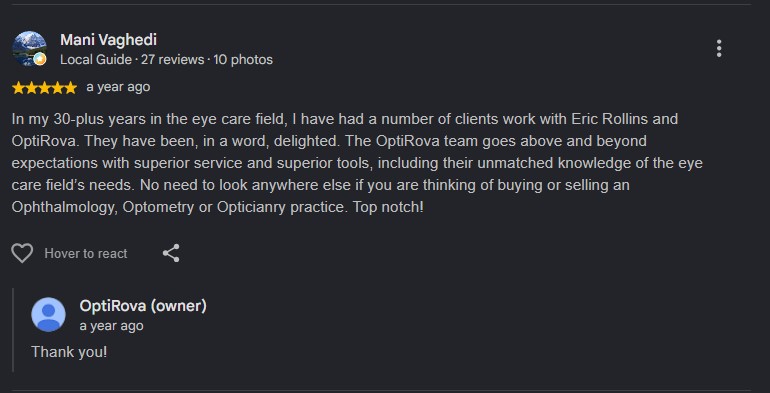
Client Review / Trust Signal
Google Business Profile review: View the review
Frequently Asked Questions
1. How long does it take to sell an optometry practice?
Most sales take about 6 to 12 months from listing to closing. However, to get the best value, it is smart to start preparing 18 to 24 months in advance. This gives you time to improve financials, update equipment if needed, and secure a strong lease.
2. Should you sell to private equity or an individual buyer?
There is no single right answer. Private equity groups may offer a higher upfront price, but often require you to stay involved for several years. Selling to an individual buyer, such as an associate, usually provides a smoother transition and better continuity for staff and patients. OptiRova helps you evaluate both options based on your goals.
3. Will my staff find out about the sale?
Confidentiality is carefully maintained. Most sales use non-disclosure agreements and discreet listings. Staff are usually informed only after a formal agreement is in place to avoid uncertainty or turnover.
For additional transparency, prospective buyers can review OptiRova’s confidentiality agreement before sensitive practice information is shared.
4. How is goodwill valued?
Goodwill reflects the reputation and loyalty built into your practice. It is influenced by factors like patient retention, consistent revenue, and the strength of your patient base. Practices with a higher percentage of medical care often have stronger goodwill because those patients tend to return consistently.
5. What is the biggest deal breaker in a sale?
One of the most common issues is the office lease. If the lease is too short or cannot be transferred, buyers may struggle to secure financing. It is important to review and extend lease terms early to avoid complications later.
Good to Read on OptiRova
Disclaimer:
All content on this blog is for general informational and educational purposes only and is provided “as is” without warranty. It does not constitute financial, legal, tax, investment, or any other professional advice.
The author and website owner disclaim all liability for any loss or damage arising from its use. Readers should conduct their own research and consult qualified professionals before making any decisions.